Top 5 Accounting Software in the Philippines
Best Accounting Software in the Philippines
Finding the best accounting software in the Philippines shouldn’t be confusing, but choosing the wrong system can cost your business time, money, and even BIR penalties. If you're tired of manual bookkeeping, spreadsheet errors, delayed financial reports, or worrying about tax compliance, it's time to upgrade to a smarter solution. The right accounting software can automate VAT reporting, simplify payroll, track inventory in real time, and give you clear financial insights so you can focus on growing your business not fixing accounting mistakes. Whether you're a startup, SME, retailer, or expanding company, we’ve compared the top accounting software in the Philippines to help you confidently choose a system that fits your budget, ensures compliance, and scales with your success.

Why the Right Accounting Software Matters for Businesses in the Philippines
Selecting the right accounting software in the Philippines is a crucial decision that impacts compliance, efficiency, and business growth. The right system ensures accurate financial management, reduces risks, and supports strategic decision-making. Here’s why it’s essential:
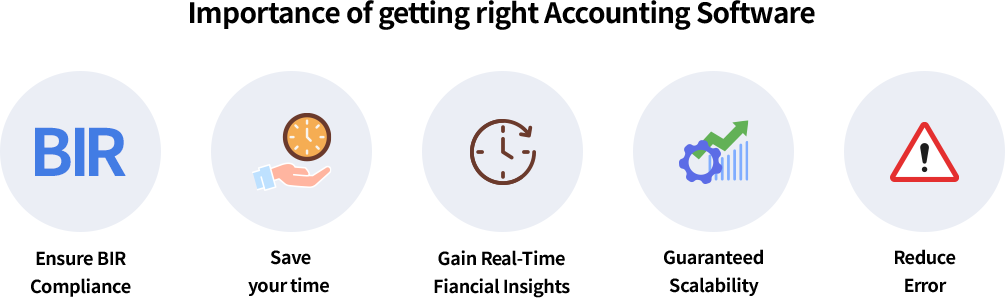
1. Ensure BIR Compliance and Avoid Tax Penalties
Businesses operating in the Philippines must comply with strict regulations set by the Bureau of Internal Revenue (BIR), including VAT reporting, withholding tax filings, and Computerized Accounting System (CAS) requirements. The right accounting software helps automate tax calculations, maintain organized records, and generate compliant reports, reducing the risk of costly compliance mistakes.
2. Save Time with Automation
Manual accounting processes often involve repetitive tasks such as creating invoices, reconciling bank statements, tracking expenses, and managing payroll. These activities consume significant time and increase the risk of human error. Modern accounting software automates these processes by integrating financial data across multiple functions. For example, invoices can be generated automatically, bank transactions can be matched with records, and payroll calculations can be processed with minimal manual input. When selecting software, businesses should look for systems that offer workflow automation, integrations with banking platforms, and automatic financial updates. This allows accounting teams to focus on analysis and strategic planning rather than manual data entry.
3. Gain Real-Time Financial Insights
One of the key advantages of modern accounting systems is access to real-time financial data. Instead of waiting for monthly reports, businesses can instantly view dashboards that show revenue, expenses, cash flow, and profitability. This visibility allows business owners and managers to quickly identify financial trends, detect potential issues, and respond to market changes. For example, real-time reporting can reveal slow-moving inventory, rising operational costs, or declining margins. When choosing accounting software, companies should prioritize solutions with customizable dashboards, analytics tools, and detailed financial reporting features. These capabilities transform raw financial data into actionable business insights.
4. Scale Your Business Effortlessly
As businesses grow, their financial operations become more complex. Companies may expand to multiple locations, add new product lines, or manage larger teams. Accounting software that works well for small operations may become inefficient if it cannot handle increased transaction volumes or additional modules. A scalable accounting system supports long-term growth by offering features such as multi-branch accounting, integrated inventory management, payroll systems, and ERP modules. Instead of replacing your system every few years, scalable software allows you to add functionality as your business evolves. When evaluating solutions, businesses should consider whether the platform can grow with their operational and financial needs.
5. Reduce Errors and Build Trust with Stakeholders
Accurate financial records are essential for maintaining credibility with investors, banks, government agencies, and business partners. Manual accounting processes often lead to mistakes such as duplicate entries, incorrect tax calculations, or incomplete financial reports. Reliable accounting software reduces these risks by enforcing structured workflows, automated calculations, and consistent record-keeping. Built-in validation systems can detect discrepancies before they affect financial reports. When stakeholders trust the accuracy of your financial data, it becomes easier to secure financing, attract investors, and make confident business decisions. For this reason, companies should choose accounting software known for reliability, audit trails, and strong financial controls.
Top 5 Best Accounting Software in the Philippines
Managing finances efficiently is crucial for any business, whether you're a small startup or a large corporation. The right accounting software can save time, reduce errors, and provide insights that help your business grow. In the Philippines, several software solutions stand out for their features, usability, and affordability. Below are the top five accounting software options to consider.
1. ECOUNT ERP
ECOUNT provides ERP & accounting software designed to automate routine accounting processes and deliver real‑time financial insights, helping both accountants and non‑accountants manage finances efficiently. Ecount is best for growing SMEs and businesses seeking automated workflows without complex accounting overhead.
ECOUNT ERP provides essential features that make accounting easier and more efficient for businesses. It integrates accounting with sales, purchasing, inventory, and payroll, allowing transactions to automatically update financial records in real time. The system also offers real-time financial reports such as Profit and Loss, Balance Sheet, and Cash Flow. With built-in accounts receivable and payable management, businesses can easily track invoices, bills, and payments. As a cloud-based platform, ECOUNT can be accessed anytime and anywhere, and its fixed pricing allows unlimited users without additional costs.
2. Xero
Founded in 2006 in New Zealand, Xero has grown into one of the world’s most widely adopted cloud accounting platforms, with millions of users globally. It’s trusted by satrtupsfor its reliability and integration capabilities. Startups often choose cloud-based accounting tools that provide automation, remote accessibility, and integration with commonly used business applications.
Xero is a cloud-based accounting platform designed to simplify financial management for businesses. It allows companies to create and send online invoices, automate bank reconciliation through daily bank feeds, and track expenses and receipts in one system. Xero also provides real-time financial reports such as Profit and Loss and Balance Sheets, giving business owners clear insights into their financial performance. Additionally, it integrates with hundreds of third-party business applications, helping companies streamline operations and manage their finances more efficiently.

3. QuickBooks Online
Developed by Intuit in 1983, QuickBooks has become one of the world’s most trusted accounting solutions for small businesses, including in the Philippines.This basic accounting platforms are preferred by freelancers, sole proprietors that need an easy-to-use solution for managing their finances.
QuickBooks is a cloud-based accounting solution that helps businesses manage their financial activities more efficiently. It enables users to create invoices, monitor expenses, and automatically record transactions through bank integrations. The platform also generates real-time financial reports such as Profit and Loss statements, Balance Sheets, and cash flow summaries. Additionally, QuickBooks supports mobile access, allowing business owners to review and manage their finances anytime and from anywhere.
4. SAP Business One
SAP Business One is part of the global SAP ERP suite, providing integrated financial, inventory, and operations management. Enterprise-grade ERP platforms are commonly used by large organizations that require integrated systems to manage operations across multiple departments.
SAP Business One is a comprehensive business management and accounting solution designed for lage and medium businesses. It helps companies manage financials, sales, purchasing, and inventory within a single integrated system. The platform provides real-time financial reporting, automated accounting processes, and strong financial controls to ensure accurate record-keeping. With its advanced analytics and reporting tools, SAP Business One enables business owners and managers to gain deeper insights into their financial performance and make more informed decisions.
5. QNE AI Cloud Accounting
QNE Software Philippines Inc. specializes in Bureau of Internal Revenue (BIR)-ready cloud accounting tools for Filipino businesses, ensuring compliance with local tax regulations. A reliable accounting platform for startups and entrepreneurs that aligns with Philippine tax laws while helping businesses streamline finances and improve overall financial management.
QNE Cloud Accounting is a cloud‑based accounting solution tailored for Philippine businesses, combining compliance, usability, and modern automation. It offers Bureau of Internal Revenue (BIR)‑ready accounting and reporting that helps you generate key financial statements and required tax forms with ease. The system includes invoice and bills management, enabling flexible billing, pricing rules, and electronic sharing of documents. It also provides multi‑user access with role‑based security so teams can collaborate securely in real time. QNE’s platform features a central dashboard and comprehensive reports for clear insights into your company’s performance.